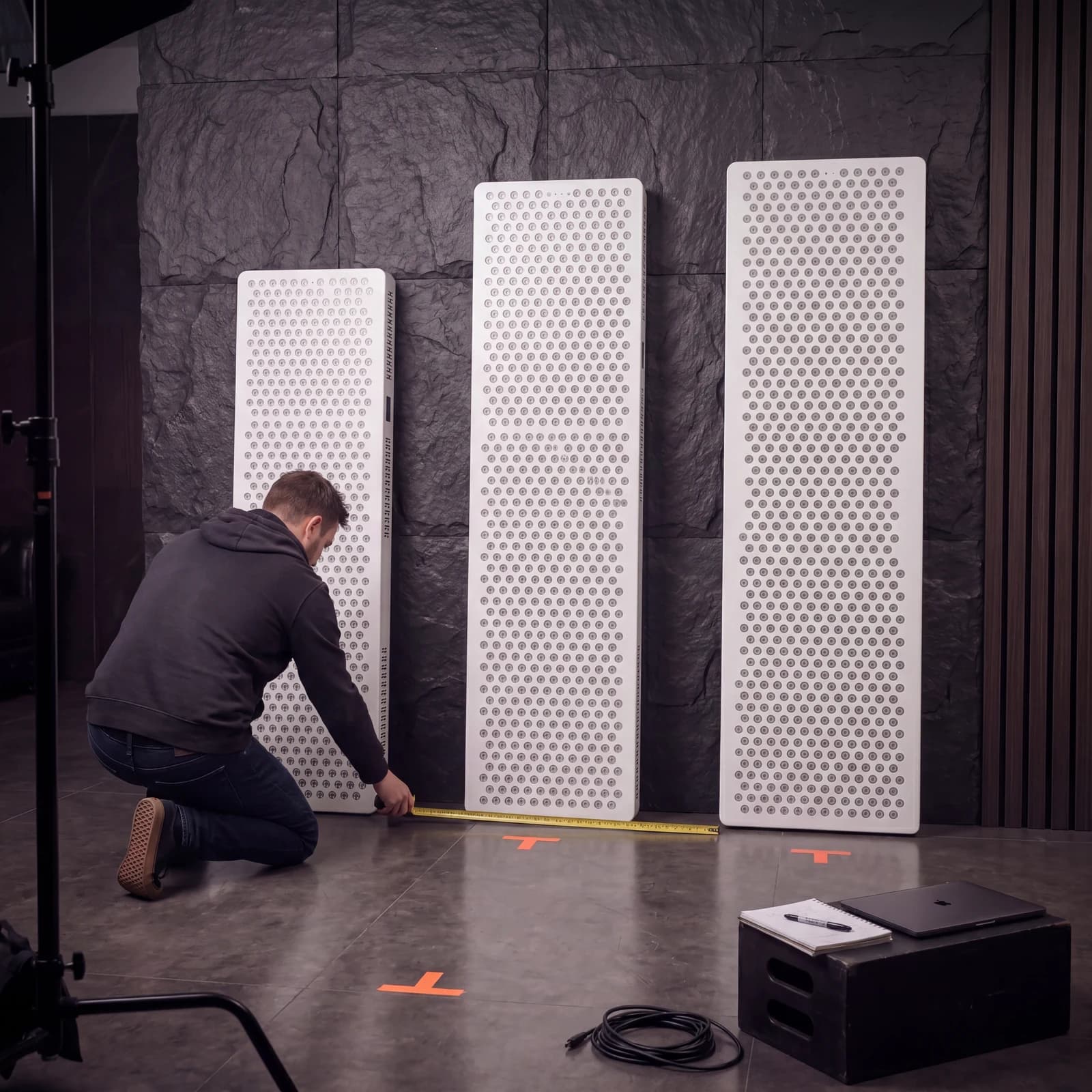
The best at-home red light therapy device is one that fits the area you want to use it on, your available space and a routine you can follow. Start with the format, then compare the exact model and complete purchase cost. A higher price, more LEDs or a larger wavelength count does not by itself establish better results.
About this guide: Hale sells masks and panels. This is a buyer's planning guide using published product information, not an independent hands-on ranking or a clinical comparison. It helps you choose a setup; it does not prescribe treatment.
Choose a format before choosing a brand
| Your priority | Format to compare | Check before buying |
|---|---|---|
| A device worn on the face | LED mask | Fit, weight, controls, charging, cleaning and eye-protection instructions. |
| A flexible setup for different body areas | Panel | Dimensions, mounting, usable space and the manufacturer's working distance. |
| A small, specific area | Targeted device | Intended use and whether repeated repositioning makes the routine practical. |
A face mask and a panel are not interchangeable simply because both emit red light. Decide which setup you will actually use. If you are choosing mainly for facial use, compare the current mask models and Canadian offers. For a larger setup, start with the Canadian panel comparison.
Build a shortlist with five checks
1. Match the device to your intended use
Read the exact model's intended-use statement and instructions. Evidence for a different device, light source or treatment protocol is not proof that the product in your basket will give the same result. If your goal is managing a medical condition, discuss device suitability with your clinician rather than choosing by a general wellness claim.
2. Measure the space you have
For a panel, allow room for the device, its mount and the instructed working distance. Check whether you will sit, stand or need a different arrangement. Measure doorways if the setup must move between rooms. Panel height and width are not the stand footprint, and a product photograph does not establish what is included.
For a mask, check the dimensions, weight and adjustment method. Think about how you will put it on, reach the controls and clean it. A cordless design may suit your routine; a wired controller may be easier for someone else. Those are practical differences, not evidence of superior results.
3. Compare a complete setup price
Write down the device price, required stand or mounting kit, delivery, tax and any import charges quoted for your address. Keep the offer currency visible. A USD price is not a CAD price, and the difference between two bare panels can disappear when their accessories differ. Do not assume a Canadian domain means domestic shipping.
4. Read the evidence behind the numbers
Ask what an output figure represents: the exact model, active mode, distance, instrument and measurement area. A peak reading in the centre is different from an average across a larger area. If two brands measured differently, their headline numbers do not support a fair ranking. Our device verification guide explains what to request. If you're weighing which device is strongest, read how strong home red light therapy should be first.
5. Check what happens after purchase
A warranty covers specified faults under its terms; a satisfaction return is a different policy. Check the time limit, whether opened products qualify, who pays return shipping and where support is handled. Read the instructions before planning a daily schedule. Use the model's guidance instead of transferring another brand's timing to your device.
Compare Hale's home options
| Device | Listed price | Size and hardware | Consider it for |
|---|---|---|---|
| Hale FACE | $549 CAD | 236 LEDs; 460 / 665 / 850 / 1064 nm; cordless USB-C charging | A cordless four-wavelength option below $600 CAD. |
| Hale RLPRO 1000 | From $3,900 CAD | 153 × 42 cm; 720 dual-chip LEDs; eight wavelengths | The smallest footprint in the RLPRO range for home or studio use. |
| Hale RLPRO 1200 | From $4,800 CAD | 184 × 42 cm; 864 dual-chip LEDs; eight wavelengths | A taller RLPRO format for a dedicated treatment space. |
| Hale RLPRO 2000 | From $6,700 CAD | 189 × 58 cm; 1,152 dual-chip LEDs; eight wavelengths | The widest RLPRO format when coverage and room space justify it. |
FACE has a one-year warranty; RLPRO panels have a three-year warranty. Read the return conditions and the selected product's current offer before ordering. Larger panels are only useful if their dimensions suit your space and intended setup.
For Canadian regulatory documentation, Health Canada Class II licence details apply to the specified RLPRO 1200 and RLPRO 2000 models. Do not extend that statement to FACE or every device in the range. A licence is not a head-to-head performance ranking.
Questions before ordering
Is a home device equivalent to a clinic treatment?
That cannot be established from the format or advertised output alone. Equipment, protocol and professional supervision can differ. Compare the exact devices and intended uses rather than assuming a home panel reproduces a clinical study.
Should I buy the largest panel I can afford?
Only if the extra size solves a practical need. Start with the usable space and mounting arrangement. Compare the three RLPRO sizes or use the panel finder to narrow the options.
Can I compare Canadian and US offers?
Yes, with the currency and complete checkout costs kept separate. Confirm delivery eligibility for your address, the selected accessories and the applicable return terms. Use the final checkout total, not an estimated blanket import surcharge.
Your next step
For a wearable facial device, view Hale FACE. For a panel setup, compare RLPRO dimensions and stand choices. If you are still deciding between brands, use the linked buying guides before choosing a product.