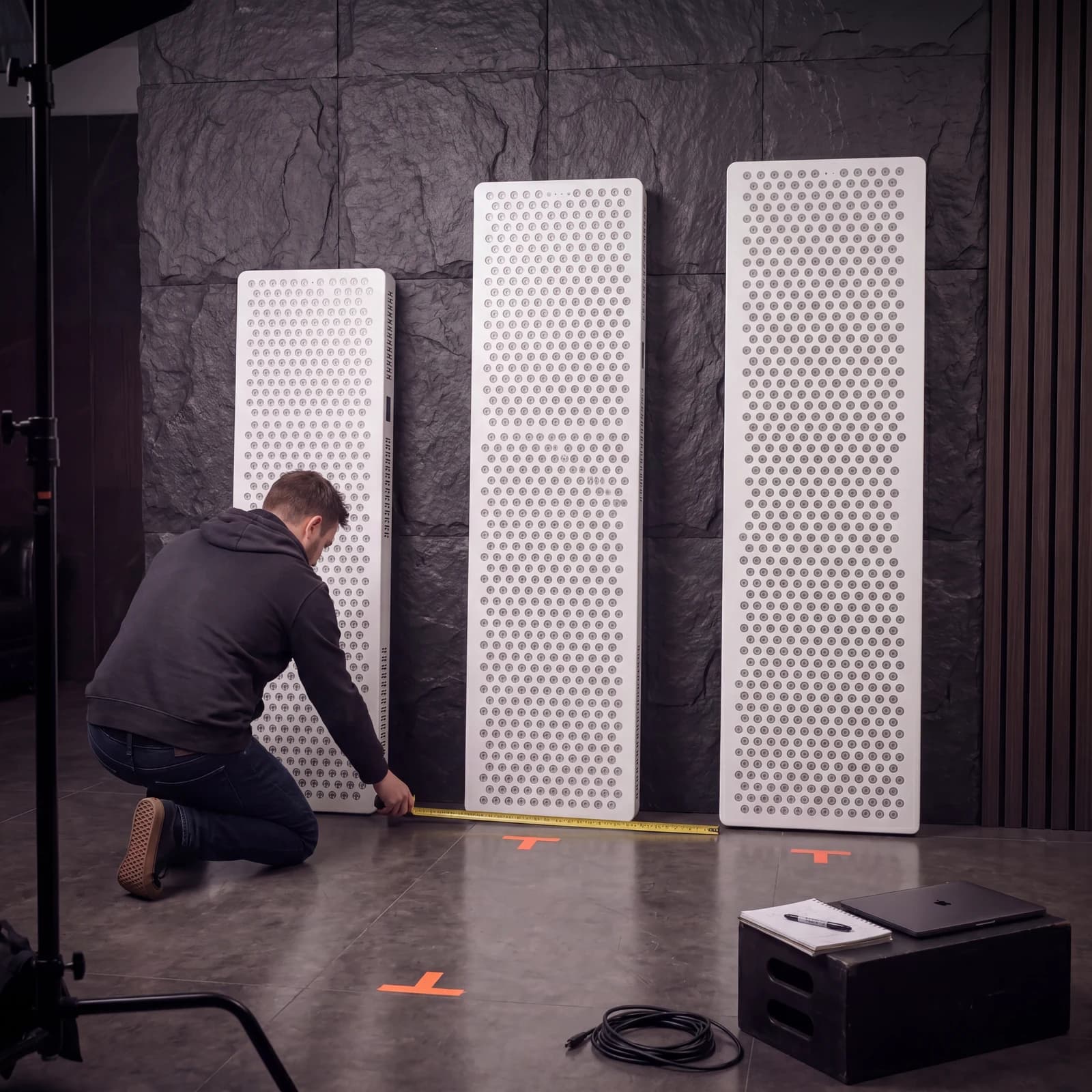
There's no single "right" strength for red light therapy, and the strongest panel isn't automatically the best one. Strength means irradiance, measured in mW/cm² at a stated distance. What your skin receives is dose: irradiance multiplied by time. At 100 mW/cm², a 10-minute session delivers 60 J/cm². A higher-output panel reaches the same dose sooner. It doesn't make the dose work better.
For reference, Hale's highest published output is ≥197 mW/cm² at 6 inches, on the RLPRO 1200 and 2000. That's a manufacturer measurement, and the rest of this page explains why the number alone shouldn't decide your purchase.
Who wrote this: Hale Health sells RLPRO panels and Hale FACE. We publish our own output figures below and label where they come from. We don't quote or rank other brands' numbers here, because figures taken at different distances with different meters can't be compared fairly.
What "strong" actually means
A panel's strength is its irradiance: how much light power lands on each square centimetre of skin, in milliwatts per square centimetre (mW/cm²). The number only means something with a distance attached. "≥197 mW/cm² at 6 inches" is a claim you can work with. "200 mW/cm²" on its own is not.
Dose is the number that connects strength to a session. The arithmetic is short:
J/cm² = mW/cm² × seconds ÷ 1,000
So 100 mW/cm² for 600 seconds is 60 J/cm². Our J/cm² dosing calculator does the same math for Hale's panels and shows its working.
Why the biggest number on the box misleads
Distance moves the number
Output drops as you step back from a panel. How fast it drops depends on the panel's size and LED layout, so there's no honest one-line conversion from six inches to twelve. Ask for a reading at the distance you'll actually use. If a seller gives a number with no distance, you can't do anything useful with it.
The meter matters
Cheap solar-power meters aren't built for a mix of red and near-infrared LEDs, and they can read high or low. A reading is only as good as the instrument and method behind it. Our device testing guide lists what a usable measurement report should state.
Peak isn't average
Some figures are taken at the brightest point in the centre of the panel. The edges of the treatment area usually get less. A centre-point peak tells you little about what your shoulders or knees receive in a full-body session.
Pulsing cuts the dose
A panel running a pulsed mode at a 50% duty cycle delivers half the energy of continuous mode over the same time. If a high figure was measured in continuous mode and you run it pulsed, your dose is lower than the arithmetic suggests. Our pulsed vs continuous guide works through it.
More light isn't more benefit
Photobiomodulation research describes a biphasic dose response. Too little light does little, and past a point, more light can reduce the effect rather than add to it (Huang et al., 2009, Dose-Response, PMID 20011653). That's why the useful question is "can this panel deliver the dose in my protocol, at my distance, in a session length I'll stick with?" and not "which panel is strongest?"
In practice, higher output buys you time. At ≥197 mW/cm² at 6 inches, one minute works out to about 11.8 J/cm². A device delivering 35 mW/cm² at your skin would need about 286 seconds to reach 10 J/cm², against about 51 seconds at 197 mW/cm². Same dose, different wait. Follow the distance and session times in your device's manual rather than stretching or shortening them to chase a number, and use the eye protection it calls for. Bright near-infrared panels aren't something to stare into.
What different formats give you
Strength is one part of the decision. Coverage is the other, and it's often the bigger one.
- LED face mask: sits close to the skin and covers the face only. Hale FACE's supplier figure is 35 mW/cm² at 6 inches, well below our panels. A mask isn't worn six inches from your face, so treat that as a spec-sheet number, not your session dose.
- Small panel: covers a face or one area at a time. Treating the whole body means several sessions back to back.
- Full-length panel: a panel such as the RLPRO 1200 (184 × 42 cm) covers most of your height in one session per side, so total time is shorter even at the same irradiance.
- Clinic device: varies widely. Ask the clinic for the device model and its output at the treatment distance, the same as you would a seller.
If you're choosing between formats, start with our panels vs masks guide or the at-home device guide.
Hale's numbers, and what they are
| Device | Size | Published output | Source of the figure | Time to 10 J/cm² at that output | Health Canada Class II licence |
|---|---|---|---|---|---|
| RLPRO 1000 | 153 × 42 cm | >160 mW/cm² at 6 inches | Hale-published manufacturer measurement | at most 63 seconds | Not on licence 111226 |
| RLPRO 1200 | 184 × 42 cm | ≥197 mW/cm² at 6 inches | Hale-published manufacturer measurement | at most 51 seconds | Listed on licence 111226 (held by the manufacturer) |
| RLPRO 2000 | 189 × 58 cm | ≥197 mW/cm² at 6 inches | Hale-published manufacturer measurement | at most 51 seconds | Listed on licence 111226 (held by the manufacturer) |
| Hale FACE | 640 × 220 mm | 35 mW/cm² at 6 inches | Supplier-documented measurement | about 286 seconds | Not on licence 111226 |
The RLPRO figures are Hale-published manufacturer measurements. Hale FACE uses the supplier's documented figure. None of them is an independent third-party test, and none of them proves a health outcome. The "time to 10 J/cm²" column is arithmetic from the published figure, shown to make the time trade-off concrete, not a recommended dose.
Every RLPRO price includes a stand: from $3,900 CAD for the RLPRO 1000, $4,800 CAD for the RLPRO 1200 and $6,700 CAD for the RLPRO 2000. Compare the three sizes.
Can you get "medical grade" red light therapy at home?
Not as a regulatory category. What you can buy is a device whose model appears on a Class II medical device licence, such as the RLPRO 1200 or 2000. "Medical grade" doesn't appear in Canada's Medical Devices Regulations, so treat it as marketing language. The red light panel licences we've checked are Class II. A licence authorizes sale in Canada for the stated intended use. Health Canada says a licence doesn't mean it approves the device, and a licence says nothing about which device is stronger or works better.
For Hale, the RLPRO 1200 and 2000 appear under Class II licence 111226, which the manufacturer holds. The RLPRO 1000 and Hale FACE are not on that licence. You can check any brand's claim yourself with our Health Canada licence guide.
Five questions to put to any "strongest" claim
- At what distance? No distance, no comparison.
- Measured with what? Name the meter and how it handles red and near-infrared light.
- Where on the panel? Centre peak or an average across the area you'll treat.
- In which mode? Continuous, pulsed, or with some LED channels switched off.
- Who measured it? The manufacturer, the seller or an independent lab, and can you see the report.
A seller who answers all five has given you a figure you can use. One who can't answer the first hasn't.
Questions about red light therapy strength
What strength of red light therapy is most effective?
No single strength is most effective for everyone. Studies use different wavelengths, distances, doses and conditions. The practical target is a device that publishes its output at a stated distance, so you can deliver the dose your protocol calls for in a session length you'll keep up.
How strong should my red light therapy be?
Strong enough to reach your intended dose in a reasonable session at the distance you'll use, and documented well enough that you can work that out. Very high output mostly shortens the session. It doesn't replace the protocol.
Is a stronger panel better?
Not on its own. A stronger panel delivers the same dose in less time. Coverage, the evidence behind the published figure, warranty and setup matter as much for a home purchase.
Can you overdo red light therapy?
The research on biphasic dose response suggests that much more light than a protocol calls for can reduce the effect rather than increase it. Stick to the session times and distances in the manual, and talk to your clinician if you have a medical condition or take photosensitizing medication.
Work out your session
Run your numbers in the dosing calculator, then compare RLPRO sizes and stands. If you'd rather talk it through, the panel finder asks four quick questions, on use, coverage, setup and budget, before suggesting a size.