Key Takeaways
- LED light therapy panels deliver red and near-infrared light across a large area, which is why they suit home and full-body use where lasers do not.
- LEDs are legitimate photobiomodulation tools, not inferior by default — but an LED panel at a distance delivers far lower irradiance than a clinical laser, so the dose is not the same.
- A real LED therapy panel publishes exact wavelengths and irradiance-at-distance; a cheap "LED red light" bulb or strip does neither.
An LED light therapy panel is a grid of light-emitting diodes that emit specific red and near-infrared wavelengths over a large surface. Nearly every home red light device is LED-based, so the real questions are not “LED or not,” but how LED panels work, how they stack up against the lasers used in most clinical studies, and how to tell a genuine therapy panel from a generic LED light dressed up to look like one.
How an LED therapy panel works
Each diode emits a narrow band of light at a designed wavelength — for example 660 nm red or 850 nm near-infrared. That light is absorbed by cytochrome c oxidase in your mitochondria, which restores electron transport and raises ATP production (Hamblin, 2018, PMID:29164625, PMC5844808). A panel packs hundreds of these diodes so it can treat a large area at once. Better panels use dual-chip LEDs (two wavelengths per diode) to fit more of the spectrum into the same board. The number of LEDs helps explain coverage and density, but it does not prove dose — that comes down to irradiance at your treatment distance.
LED vs laser: legitimate, but not identical
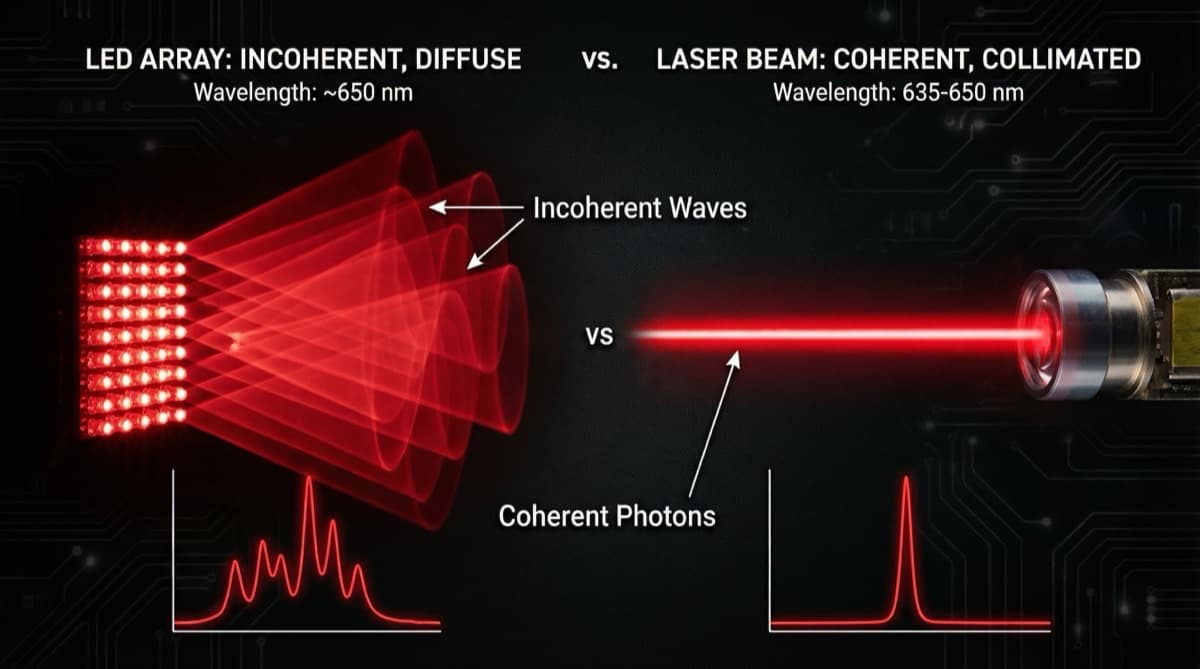
Most photobiomodulation research used lasers, which has led to a myth that LEDs are second-rate. They are not inherently inferior — LEDs are widely accepted photobiomodulation sources. But there is an honest difference in delivery: an LED spreads light over a wide area at lower intensity, while a laser is collimated and concentrated. In one in-vivo comparison, the LED arm delivered only about 135 mW/cm² against 250–330 for the lasers (Pruitt et al., 2022, PMID:35208178, Metabolites). So the mechanism transfers, but you cannot assume an LED panel at a distance delivers a laser’s dose. This matters because dosing is biphasic — both too little and too much light reduce the effect (Huang et al., 2011, PMID:22461763, PMC3315174) — so a panel’s published irradiance at a stated distance is the number that matters, not its LED count. For the full comparison, see LED vs laser devices.
A real LED therapy panel vs a cheap LED light
“LED red light” on a marketplace can mean a purpose-built therapy panel or a screw-in bulb, an RGB strip, or a heat lamp with a red tint. The difference is verifiable specs. A genuine therapy panel publishes the exact therapeutic wavelengths (630–850 nm and up), an irradiance figure with the distance it was measured at, and real build and safety documentation. A generic LED product publishes none of that, because it was not designed to deliver a therapeutic dose. If a listing cannot tell you its wavelengths and irradiance-at-distance, it is a light, not a therapy device. The signs of a high-quality device and what to avoid on Amazon cover the tells in detail.
What to look for in an LED panel
Exact wavelengths, irradiance published with a distance, coverage that fits your body, dual-chip LEDs for spectrum density, a real warranty, and proper electrical certification. Hale’s RLPRO panels use dual-chip LEDs across eight wavelengths (630–1060 nm), publish ≥197 mW/cm² at 6 inches on the 1200 and 2000, and carry a 3-year warranty with an ETL-certified build. To compare panels on those specs, start at the panel buying guide.
Frequently Asked Questions
Are LED light therapy panels as effective as lasers?
LEDs are legitimate photobiomodulation sources, not inferior by default, and they cover far larger areas than lasers. But an LED panel at a distance delivers lower irradiance than a concentrated clinical laser, so the dose is not identical. Judge a panel by its published irradiance-at-distance, not by whether it is LED or laser.
How many LEDs should a panel have?
LED count helps explain coverage and density but does not prove dose. A panel with more LEDs but no published irradiance-at-distance is not necessarily better than one with fewer LEDs and honest specs. Coverage and irradiance matter more than the raw count.
Is a cheap LED red light the same as a therapy panel?
No. A purpose-built therapy panel publishes exact therapeutic wavelengths and irradiance with a measurement distance; a generic bulb, strip, or tinted heat lamp does not, because it was not designed to deliver a therapeutic dose.
LED is the right technology for home and full-body light therapy — it is what lets a panel treat a large area safely and affordably. Just remember that “LED” on its own guarantees nothing. The panel worth buying is the LED panel that publishes its wavelengths and its irradiance at a real distance, so you can check that it delivers an actual dose.